Bartók's String Quartets
By Jim Samson

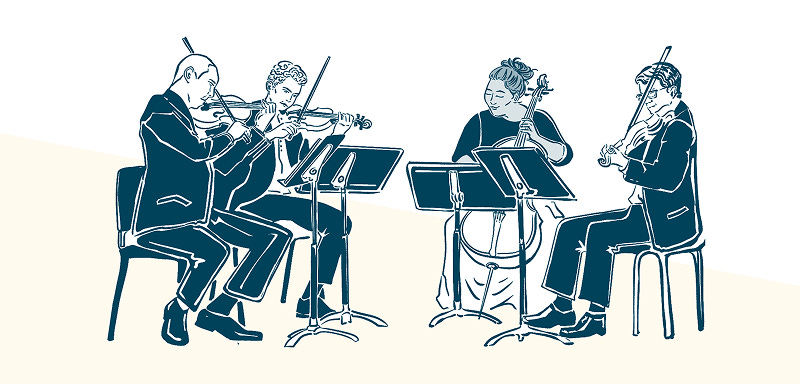
Welcome back to The Art of Listening! In this installment, we examine a body of works by one of the titans of 20th-century composition: Béla Bartók (1881–1945). Be sure not to miss our Bartók playlist, our further reading and viewing recommendations, and what we’re talking about this month at CMS.
In the late 19th and early 20th centuries, a new wave of compositional approaches—which now fall under the umbrella of “modernism”—began to emerge. Although the composers of this persuasion were united in their hunger for experimentation, each one brought something of their own culture and musical upbringing to their style.
Bartók cut a unique figure in the fabric of modernism. He came from Hungary and studied the folk music of his culture vigorously. He also had a deep respect for the practices of Western classical music. Yet, from these two ostensibly traditional sources, he forged a new kind of music, one which stretched the bounds of conventional music theory and influenced generations of future composers.
Of all the brilliant compositions brought into the world by Bartók, it is perhaps his string quartets that have had the most resounding impact. With these works, Bartók co-opted one of the most well-established genres of Western classical music to introduce some of the most original ideas in all of modernism. In this newsletter, musicologist Jim Samson delves into the significance and inner workings of these revolutionary quartets.
The string quartet in the 19th century tells a story in which the stylistic and social histories of music are closely intertwined. In the world of Viennese Classicism, the quartet was a private medium in which the four performers engaged in an intimate conversation, notionally of equals. What was said mattered, of course, but who was saying it mattered no less. However, by the time Brahms came to write his first two string quartets in 1873, the genre had already taken on much of the public quality associated with the symphony, in part because professional performances had migrated from the salon to the concert stage. Thematic sharing and instrumental characterization were more difficult to sustain as string quartets became more symphonic, but at the same time the quartet could never really aspire to the “massive” sonorities associated with the symphony. This may be why several late 19th-century composers seemed more at home with chamber genres involving five or six instruments.
In the first half of the 20th century there was a rethinking—as well as a revival—of the medium, associated initially with the string quartets of Claude Debussy and Maurice Ravel (one apiece), and then with the six quartets by Béla Bartók (1881–1945). Bartók’s cycle registered a personal journey in musical style that some commentators have likened to that of Beethoven. Indeed, the opening Lento from the First String Quartet (1908–9), characterized by imitative writing of sustained, brooding intensity, has on occasion been compared directly to the slow fugue that opens Beethoven’s Op. 131, albeit freighted with further influences from German late-Romantic composers. In the (progressively faster) second and third movements, such influences give way to materials drawn instead from the traditional folk music which Bartók had already begun to collect in agrarian settings, though it needs to be stressed that his compositional use of this music was far removed from the spirit of Romantic nationalism.
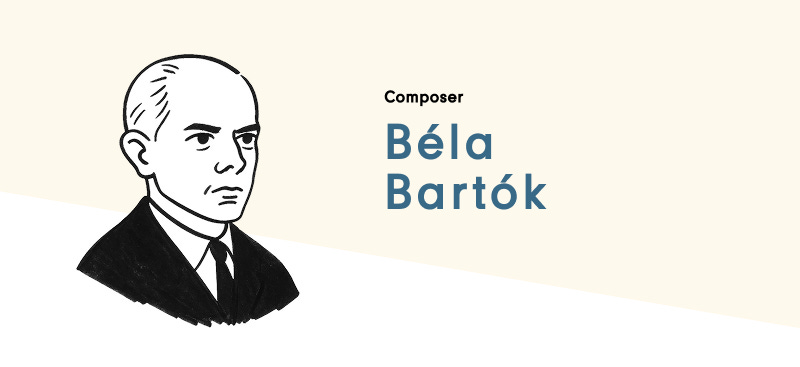
Following this first quartet—indeed in parallel with it—Bartók experimented with a range of modernist techniques in several short piano pieces, beginning with his Op. 6, 14 Bagatelles (1908), and when he came to compose his Second String Quartet (1917), he was ready to integrate these techniques with materials garnered from his ethnological research. He did not confine his collecting to Magyar (Hungarian) communities in Hungary and Romania, but extended it to the Eastern Black Sea region of Turkey, and even to North Africa. Indeed, some of the music he transcribed in the Biskra region of present-day Algeria clearly left its imprint on the second movement of the Second Quartet. In this way, so-called “folk music” was harnessed to a modernist, rather than a Romantic, aesthetic.
The single-movement Third String Quartet, composed in 1927—the most compressed and radical of the cycle—perfectly demonstrates how Bartók could forge a quite new tonal language that avoids the triad (major/minor chords) as a fundamental harmonic unit. Thus, the work establishes pitch centers (C and C-sharp in the first movement, D and E-flat in the second) and builds modes (scales) on these pitches to create what Bartók himself described as “polymodal chromaticism.” If we seek an ancestry, we might look to the modal practices developed in Russia in the 19th century, and by Debussy in the early 20th. The severely modernist idiom of this work is extended in the Fourth String Quartet of 1928, but with two further innovations. One is the subgenre Bartók called “night music”: a kind of Impressionism—think Debussy or Ravel—stylizing the sounds of nature, including insect noises. This is found most notably in the slow, middle third movement—the central kernel of the whole quartet. Nature sounds also feature prominently in the second and fourth of the five movements, both of which are both scherzo-like, with the second movement played entirely con sordini (with the strings dampened by mutes) and the fourth movement entirely pizzicato. The other innovation involves the arch-like symmetry that describes the overall form, as well as separate components of the form. Arch designs in music invite careful scrutiny. Since music flows through time, our perception of an arch—which is essentially a visual phenomenon—may well locate the peak some way beyond the midway point. It is therefore of some interest that several researchers have identified the Golden Section ratio (0.618), and the related Fibonacci number sequence, as integral to Bartók’s compositional methods.
The Fifth String Quartet (1934) also has a five-movement arch structure, with night music in the slow second and fourth movements. But Bartók introduced something new in the third movement: his asymmetrical rhythms alla bulgarese. In fact, these so-called “aksak” (limping) rhythms, which are various subdivisions of a 9/8 meter, are not just Bulgarian. They are found all over the Eastern Mediterranean, and are really simplifications of Ottoman rhythmic cycles (usuller), but they do introduce a lively, accessible tone that is in sharp contrast to the modernist stringencies found in the Fourth String Quartet, and even more in the Third. This foreshadows the marked simplification of style often noted in Bartók’s later music, including his last string quartet, which was composed just as war was breaking out in 1939. This Sixth String Quartet returns to a traditional four-movement scheme, with each movement preceded by an elegiac “motto” theme, presented at the outset in solo viola. In the finale this “motto” theme reaches into the main body of the movement to form a bleak, almost sepulchral conclusion to the work. But perhaps the most extraordinary moment is the impassioned, high cello recitative, marked rubato (with rhythmic freedom), that unexpectedly interrupts the second movement. It relates to a form of sung “story-telling” derived from folk traditions, and its searing emotional intensity draws us into the heart of the story.

Jim Samson is Emeritus Professor of Music at the University of London. He is currently an Editor-in-Chief for Grove Music Online and a Series Editor of the Peters Complete Chopin. He is a Fellow of the British Academy, and holds the Order of Merit of The Polish Ministry Culture, an honorary doctorate from the Ionian University, and the Irish Research Council Harrison Medal. His book Virtuosity and the Musical Work was awarded the Royal Philharmonic Book Prize, and his edition of the Chopin Ballades was named Edition of the Year in the Rhinegold Publishing International Piano awards. His latest monograph is Black Sea Sketches: Music, Place and People (2021).
Further Reading
The Life and Music of Béla Bartók – Halsey Stevens
The classic, definitive biography of Bartók.
Béla Bartók – David Cooper
A more recent biography of Bartók, incorporating new scholarship and providing original examinations of his works.
Twentieth-Century Chamber Music – James McCalla
An overview of 20th-century chamber music, including discussions of Bartók’s string quartets and their significance.
An introduction to chamber music.
What We’re Talking About This Month
CMS announced our upcoming season this past week. Our 26–27 offerings include a celebration of American composers across the centuries, from Copland to Herrmann to Beach; an eight-concert series of Beethoven’s piano sonatas; a Winter Festival devoted to Mozart’s most extraordinary chamber works; an evening centered around Saint-Saëns’s The Carnival of the Animals; and dozens of other performances of cherished repertoire, hidden gems, and new works.

Dive deeper into Bartók’s quartets with two engrossing lectures, by composer and scholar Bruce Adolphe, on the Fourth and Sixth Quartets.
For a treasure trove of video performances of Bartók’s quartets—by world-renowned quartets, including the Emersons, Eschers, Calidores, and more—and more of his visionary chamber music, peruse our Digital Archive here. Here’s one of our favorites:
Coming up at CMS: our Winter Festival, celebrating the history of the violin from the Baroque era through the 20th century. All the programs are absolute can’t-misses, but we’re particularly excited for our Violin Visionaries concert (Feb. 28), featuring Enescu’s Sonata No. 3 for Violin and Piano—the subject of our last newsletter. Read more about the festival and purchase tickets here.
Really fascianting how Bartók managed to fuse folk music with modernism without falling into the Romantic nationalism trap. The polymodal chromaticism approach is briliant because it sidesteps the whole major/minor system while still maintaining pitch centers. I've always wondered how he pulled off those Bulgarian rhythms in the Fifth Quartet without making them sound forced, feels like he genuinely absorbed those traditions rather than just borrowing surface-level patterns.